

- How much tax do you pay when you sell a property?
- What Changed with Law 30-26
- Who Is Exempt from Paying
- How long do you have to pay it?
- What about the 3% transfer fee? You don’t have to pay that.
- The problem if you bought off-plan or many years ago
- What You Need to Have in Order Before Selling
- Frequently Asked Questions About Taxes When Selling a Property
- Summary: Taxes When Selling a Property in Three Points
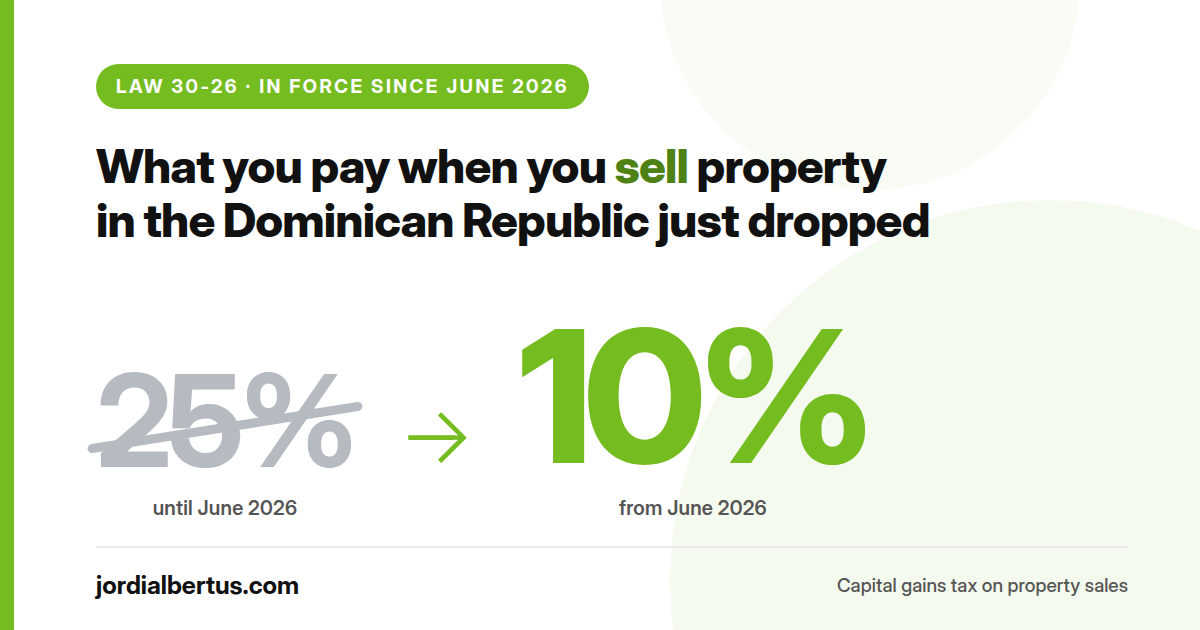
As of June 2026, the tax on the sale of a property in the Dominican Republic is 10% of the gain, payable as a single, final payment. If you bought the property for $200,000 and sell it for $260,000, you pay tax on the $60,000 gain, not on the sale price. Before that date, an individual could be taxed at a rate of up to 25%. Here, I’ll explain exactly how much you’ll pay, who is exempt, what your deadline is, and the practical problem many sellers will face.
How much tax do you pay when you sell a property?
10% of the capital gain. This is established by Law 30-26, enacted on June 18, 2026, and is a one-time, final payment: it is not subsequently added to your annual income tax return.
The gain is calculated by subtracting the adjusted acquisition cost from the sale price. That cost is adjusted for inflation using the multipliers published by the DGII itself, so the taxable gain almost never matches the gross difference between what you paid and what you received. You can verify the transfer calculations using the DGII’s official calculator.
What Changed with Law 30-26
Until June 18, 2026, individuals were taxed according to the income tax scale, which could reach 25%, and real estate holding companies paid 27%. As of that date, both are subject to a single, flat rate of 10%, provided the corporation does not engage in commercial activity. Companies engaged in the real estate business remain under the general tax regime: the 10% rate applies to those who sell their property, not to those who make a living by buying and selling.
Who Is Exempt from Paying
Primary residence with reinvestment. If you sell your primary residence and reinvest the entire amount in another home within six months, you are exempt. If you reinvest only a portion of the proceeds, the exemption applies proportionally to the amount actually reinvested.
People 65 years of age and older. An individual over the age of 65 who transfers ownership of his or her primary residence is exempt, with no limit or requirement to reinvest.
Be careful with the concept of a primary residence: it’s not the same as a vacation home that you use for three weeks a year. If your situation is borderline, you should check this before selling, not after.
How long do you have to pay it?
Six months from the date the transfer of ownership is finalized. This is the same time limit that applies to the transfer tax paid by the buyer, so in practice, the two obligations run concurrently.
What about the 3% transfer fee? You don’t have to pay that.
This is the most common misunderstanding. The 3% real estate transfer tax is paid by the buyer, because the buyer is the one who needs the title in their name. It remains in effect in 2026 and was not changed by Law 30-26. As the seller, you are subject to capital gains tax. I explain this in detail in the article on real estate transfer tax.
The problem if you bought off-plan or many years ago
Here’s the tricky part. The 10% is calculated based on your profit, and your profit depends on your tax basis—what the DGII recognizes that you paid. If that basis isn’t properly documented, the calculation gets complicated.
This is the case for many people who bought off-plan years ago, who paid in installments through successive transfers, or whose contract stated a value different from the actual one. Without a solid acquisition cost, the profit on which you’re taxed may be much higher than what you actually made. If this applies to you, start gathering your purchase agreement, payment receipts, and the transfer tax settlement from when you bought the property. These three documents are what establish your tax basis.
What You Need to Have in Order Before Selling
The DGII’s local office verifies that the seller is up to date with their tax obligations before authorizing the transfer. In practice, this means having your IPI up to date if your property exceeds the exemption threshold, a clean title certificate with no outstanding liens or encumbrances, and, if you’re selling through a corporation, that corporation’s tax returns up to date. Overdue IPI payments do not prevent a sale, but they delay closing, and a delayed closing means a buyer who loses interest.
Frequently Asked Questions About Taxes When Selling a Property
Does the 10% also apply if I am a nonresident alien?
Yes. Law 30-26 refers to individuals without distinguishing by residence, and the Dominican Tax Code already taxed nonresidents on their income from Dominican sources under Article 270, defining such income as that derived from property located in the country, as specified in Article 272. A property in the Dominican Republic generates income from Dominican sources whether you sell it from Miami, Madrid, or Bávaro.
What if I sell at a loss?
There is no capital gain, so there is no tax. But the transaction must still be reported: the exemption is not automatic; it must be substantiated.
How much does it cost me to sell in total, including everything?
On the profit, 10%. On the price, the brokerage commission: in the Dominican market, it ranges from 5% to 6% and is paid by the seller, not the buyer. In a standard 5% transaction, 2.5% goes to the seller’s agent and 2.5% to the buyer’s agent. Legal fees range from 1% to 1.5% of the price, depending on the complexity of the transaction, and in practice, the buyer covers these along with the 3% transfer tax and registration fees. As the seller, your actual costs are the commission and the 10% on the profit.
Did Law 30-26 change anything else that affects me as a homeowner?
Yes. The 2% tax on registered real estate transactions will be reduced to 1% in 2027 and eliminated in 2028. It is not the 3% transfer tax; it is a separate tax, and it is important not to confuse the two.
Can I claim the primary residence exemption if I reinvest abroad?
The text of Law 30-26 does not prohibit this: it refers to reinvesting the total amount in the purchase of a new home, without requiring that it be located in the Dominican Republic. That said, the implementing regulations have not yet been published, and tax exemptions are interpreted narrowly. If you plan to sell here and buy abroad, confirm this in writing with your advisor before signing.
Summary: Taxes When Selling a Property in Three Points
Starting June 18, 2026, you pay a one-time 10% tax on the profit, not on the price. You have six months from the date the transfer is finalized. You are exempt if it is your primary residence and you reinvest the entire amount in another one within six months, or if you are over 65 years old.
Are you thinking about selling your property in the Dominican Republic and not sure how much you’ll end up with after taxes? Message me on WhatsApp at +1-829-962-7186, and we’ll calculate it based on your specific situation, using your numbers. You can also email me at jalbertus@plusval.do.
Information updated as of August 2026. This does not constitute tax or legal advice. Law 30-26 is pending implementing regulations: consult a professional regarding your specific situation before making any decisions.
Thinking about investing in the Dominican Republic?
Get a professional, no-pressure opinion before you decide. Write to me directly and I'll help you analyze your case.