

- Registration is what makes you the owner — not the signature
- Trusting a status certificate that is three weeks old
- Buying a constancia anotada and thinking it is a title
- Accepting the developer’s pre-construction contract as it comes
- Signing without knowing that due diligence protects your warranty
- Buying in your personal name without having thought about it
- Frequently asked questions
- Can foreigners buy property in the Dominican Republic?
- Does the contract have to be notarised, or is a private signature enough?
- How long do I have to register the sale?
- Do the property’s debts pass to the buyer?
- Is there a clear warranty period on construction?
- So, is it safe to invest in Dominican Republic real estate?
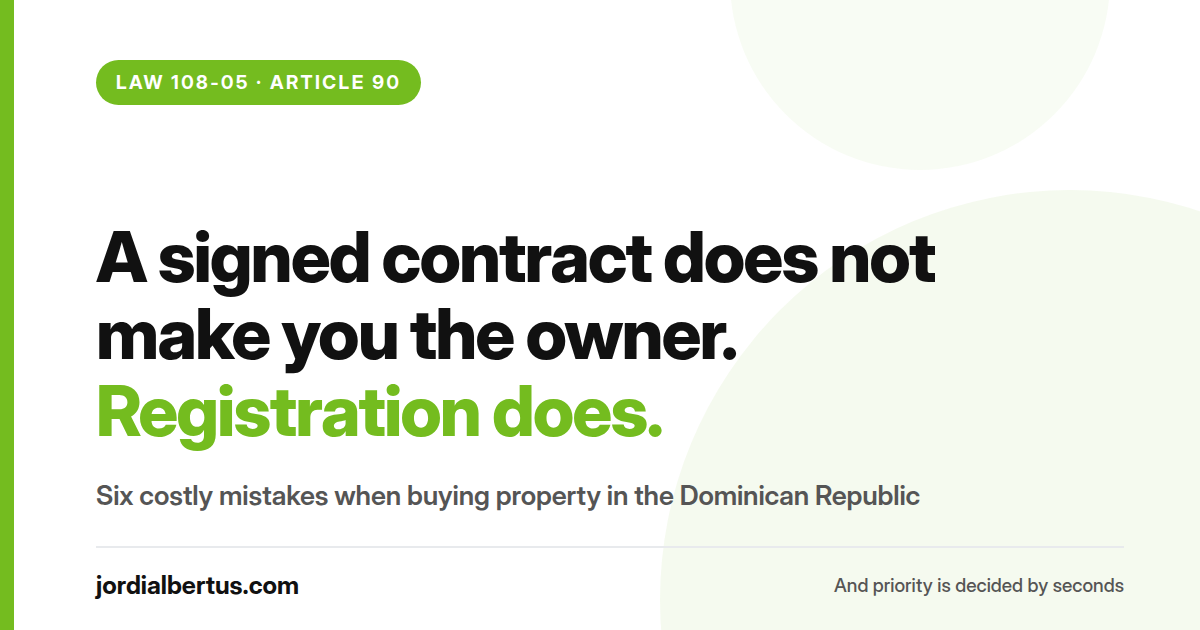
Is it safe to invest in Dominican Republic real estate? Yes — and the country has a modern, computerised land registry that most of the Caribbean does not. But the risk that catches foreign buyers is not the one they expect. It is almost never the price, the neighbourhood or the developer’s brochure. It is the contract, the registry, and the days that pass between signing and getting the property into your name. Because here is the part nobody tells you before you fly down: in this country a signed contract does not make you the owner. It makes you a creditor. The registry makes you the owner. Here are the six mistakes that cost the most money, and how each one is avoided.
Registration is what makes you the owner — not the signature
Article 90 of Law 108-05 on Real Estate Registry states that registration is «constitutive and validating of the right, charge or encumbrance registered». In plain English: until the sale is recorded at the Registry of Titles, your ownership right has not come into existence. You hold a contract that binds the seller to you, and nothing more.
The General Regulation of the Registry of Titles adds the uncomfortable part: priority is governed by «the date, hour, minute and seconds the file enters the Registry of Titles». It is a race, and it is won by whoever files first.
What that means in practice: between your signature and your filing, the seller is still the registered owner. If in those days someone records a mortgage over the property, a creditor of the seller attaches it, or the seller sells again and that buyer files before you — they win. What you are left with is a lawsuit against the seller, not the house.
How to avoid it: file immediately. The Registrar has 30 business days to review the file, but the clock that matters is the one on your filing, not on their answer. The procedure is set out in the official Transfer by Sale form published by the Registro Inmobiliario.
Trusting a status certificate that is three weeks old
The Certificate of Legal Status of the Property (Certificación del Estado Jurídico del Inmueble) is the document that tells you whether there are mortgages, oppositions or litigation over the property. Anyone with an interest can request it — you do not need to be the owner — and it costs RD$1,000 at the counter.
The mistake is treating it as a clean bill of health valid for a few weeks. It is not. The certificate reflects the state of the registry at the second it is issued. The Registry cannot predict what will be filed tomorrow. Between your certificate and your filing, anything can be recorded.
How to avoid it: compress the window between certificate, signature and filing to the minimum. And request it yourself, directly from the Registry. Never accept documents from the seller’s hands — Dominican law firms warn explicitly that these are forged.
Buying a constancia anotada and thinking it is a title
This is the most expensive mistake there is with land, and the one that hits hardest if you are buying a lot to build on.
A constancia anotada covers a portion of a larger parcel that was never individualised. As one Dominican firm puts it, the holder «knows how much land they own in terms of surface area, but the registry system has not yet formally determined where that portion is located».
You know you own 800 square metres. You do not know which ones.
The consequences are concrete: no bank will give you a mortgage over an abstract surface area, you cannot sell off part of it without subdividing first, and boundary disputes with neighbours have no clear registry answer. And there is a risk almost nobody mentions: when the parcel is finally surveyed with modern satellite technology, discrepancies can appear against surface areas documented decades ago. You can discover you bought fewer square metres than you paid for.
Since Law 108-05, no new constancias anotadas are issued — but a great many are still in circulation and still change hands.
The good news, and it is out of date on almost every English-language blog: since Resolution 790-2022 of the Supreme Court of Justice there is a parcel regularisation route — an administrative procedure that locates and individualises the portion without litigation, provided there is no conflict or objection. Resolution 82-2025 simplified it further and left judicial deslinde as the exception, for contested cases only. The work is carried out by an authorised surveyor, costs RD$1,000 per resulting parcel, and has a 45-business-day deadline.
How to avoid it: if what you are buying is a constancia anotada, know it before you sign, and negotiate who pays for the regularisation and who absorbs the time it takes. This is not a fatal defect. It is a cost and a delay that somebody has to carry, and who that somebody is gets decided in the contract.
Accepting the developer’s pre-construction contract as it comes
A pre-construction contract is an adhesion contract: the developer drafts it and you cannot change its terms. Law 358-05 on Consumer Protection defines it as such, and in Article 83 it declares null any clause that releases the supplier from liability for defects affecting the essential usefulness of the goods, waives rights granted by law, reverses the burden of proof to your detriment, allows the terms to be changed without notifying you, or imposes excessively onerous conditions.
That is your real weapon against a one-sided contract, and almost no foreign buyer knows they have it. The consumer protection agency sets out the basics in its guide .
And now the fact that matters most and that you will not read on real estate blogs: the trust structure is not mandatory. Law 189-11 allows a project to be structured as an autonomous estate (fideicomiso), separated from the developer’s own assets and beyond the reach of their creditors. It is excellent protection. But it is voluntary. If the project you are buying into is not held in trust, your deposits go into the developer’s estate and are exposed to their creditors like any other asset of theirs.
And note the nuance: even where the project is held in trust, that protects the project’s assets. Whether it protects you depends on how the trust deed is drafted and whether you are named as a beneficiary.
How to avoid it: ask in writing whether the project is held in trust, with which trustee, and ask them to explain your position inside that structure. If the answer is vague, you have learned something important. If you are at this stage, read what I explain about the purchase and sale agreement.
Signing without knowing that due diligence protects your warranty
The Dominican Civil Code obliges the seller to warrant you against eviction and against any charges claimed over the property that were not declared at the time of sale. It is a powerful protection and it applies even if the contract says nothing about it.
But Article 1629 attaches a condition worth reading twice: the seller is liable unless the buyer knew, at the time of the sale, of the risk of eviction, or bought at their own risk.
In other words: if you knew there was a problem and signed anyway, you lose the protection.
That is why prior investigation is not a formality or an optional expense. It is what preserves your legal warranty. And it is why it should be documented and dated: what you asked for, what the Registry answered, and what you knew on the day you signed. In the sales contract I go through what each clause should cover.
Buying in your personal name without having thought about it
It is the natural thing to do and often the right one, but it has consequences a foreign buyer rarely calculates: the property is exposed to any personal claim against you, and on your death it enters the Dominican succession regime with its full tax treatment.
How to avoid it: not by avoiding it as a rule, but by deciding it. Buying through a company or a trust carries formation and maintenance costs that do not always pay for themselves. It is a ten-minute conversation with a lawyer before you sign, not after.
Frequently asked questions
Can foreigners buy property in the Dominican Republic?
Yes. Foreign buyers have the same rights as Dominican nationals when acquiring real estate, with no special permit required and no restriction on coastal or resort property. You do not need residency to own. What you do need is the same registry diligence any Dominican buyer needs — which is what the rest of this article is about.
Does the contract have to be notarised, or is a private signature enough?
The Registry of Titles accepts both: an authentic deed, or a private document with the signatures legalised by a notary. What changes is the scope. In an authentic deed the notary drafts the instrument and its content carries public faith. With a legalised private signature the notary only certifies that the signatures belong to the people who claim them: the content of the contract is not backed by the notary.
How long do I have to register the sale?
The deadline that is genuinely mandatory is the tax one: six months from the transfer instrument to pay the transfer tax, or surcharges accrue. I cover this in detail in the article on the real estate transfer tax. For registration itself there is no equivalent statutory deadline — but every day that passes is a day in which somebody else can file before you.
Do the property’s debts pass to the buyer?
Article 90 of Law 108-05 is categorical: over registered property there are no hidden charges that are not on the register, except those arising from the Water and Mining laws. What is on the register affects you; what is not, does not. That is why the legal status certificate is non-negotiable. Tax debts such as the IPI property tax are a separate matter and do follow the property.
Is there a clear warranty period on construction?
Here it is worth being honest: it is disputed. The Civil Code establishes ten-year liability for builders and architects for the ruin of the work, and also a five-year period for major works following the amendment introduced by Law 585 of 1941. There are further periods set by regulation, plus the consumer agency’s recommendations. Different sources give different figures, and there are Dominican lawyers who question the validity of periods fixed by regulation. If your case turns on this, take it to a lawyer before you sign.
So, is it safe to invest in Dominican Republic real estate?
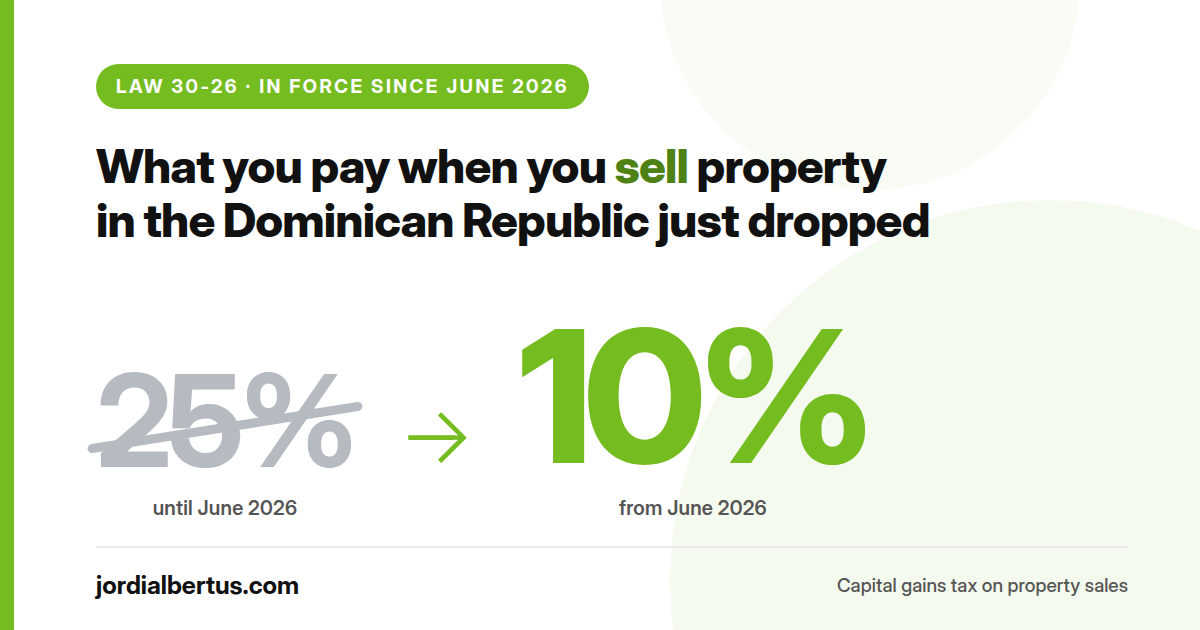
It is — for the buyer who treats the registry as the thing that matters and the contract as the thing that gets you there. The contract does not make you the owner; the registry does, and priority is decided in seconds. The legal status certificate is a photograph of the instant it was issued, not a safe-conduct. A constancia anotada is not a title. The trust structure in a pre-construction purchase is voluntary, not mandatory. And if you knew there was a problem and signed anyway, you lose the warranty. Get those five right and the Dominican Republic is as safe a place to buy as anywhere in the region. Get them wrong and no amount of yield projection will save you. When the time comes to sell, it is also worth knowing what tax you will pay on the gain.
About to sign, and want someone to check where the property actually stands before your money moves? Message me on WhatsApp at +1-829-962-7186 and we will go through your specific case. You can also email me at jalbertus@plusval.do.
Informational content, current as of August 2026. This is not legal advice. Every transaction has its particularities: consult a Dominican lawyer before signing.
Thinking about investing in the Dominican Republic?
Get a professional, no-pressure opinion before you decide. Write to me directly and I'll help you analyze your case.