- Why there is no double taxation treaty between the USA and the Dominican Republic
- So how do you avoid paying twice? With the credit, not a treaty
- The 3.8% that does get taxed twice
- Confotur and the IRS: what the DGII forgives, Washington collects
- Three mistakes I see American buyers make
- What happens when the owner passes away
- FAQ: double taxation USA Dominican Republic
- Is there a double taxation treaty between the USA and the Dominican Republic?
- Do I have to report a Punta Cana condo to the IRS?
- Can I deduct Dominican tax from what I owe the IRS?
- Does Confotur exempt me from paying taxes in the United States?
- Should I buy through a Dominican company?
- Can I do a 1031 exchange from the US into the Dominican Republic?
- Will the IRS find out I own property in the Dominican Republic?
- How to invest here without overpaying
No. An American who invests in the Dominican Republic does not pay tax twice on the same income. But the reason is not the one almost everyone gives me on the first call: there is no double taxation treaty between the USA and the Dominican Republic. What protects you is not a treaty, it is a rule inside the US tax code itself. And that changes quite a few things, including one part of your bill that does get taxed twice and that nobody warns you about.
I have been selling property in this country since 2007, mostly to people who live abroad. American buyers arrive with the most mistaken idea about this: they search “tax treaty Dominican Republic”, find articles about other countries and assume it works the same way here. Double taxation USA Dominican Republic is not solved the way it is in countries that do have a treaty.
Why there is no double taxation treaty between the USA and the Dominican Republic
Because it was never signed. In the IRS official list of income tax treaties, under the letter D you will only find Denmark. And the picture is the same from this side: the Dominican Republic has treaties with Canada and Spain. With the United States, no.
But no treaty does not mean no transparency. The two countries signed a tax information exchange agreement in 1989 and expanded it in 2016 with FATCA: Dominican financial institutions identify the accounts of US taxpayers, report them to their government, and the government sends them to the IRS, automatically, every year.
Put plainly: when it comes to double taxation USA Dominican Republic, you don’t have the treaty that protects you, but you do have the pipeline that watches you. I mention it because every so often someone asks me whether “nobody finds out” down here. They do.
So how do you avoid paying twice? With the credit, not a treaty
With the foreign tax credit, claimed on Form 1116. It is a unilateral mechanism in US law: it works whether or not there is a treaty. You report your worldwide income, including the rent from your Punta Cana condo, and subtract what you already paid here.
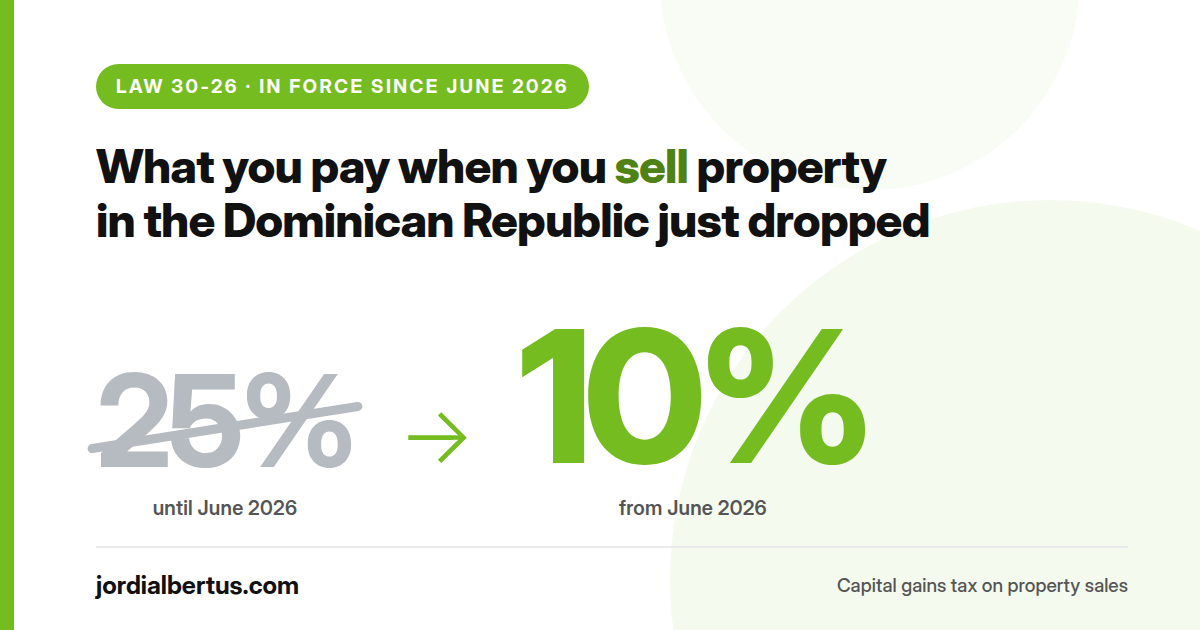
What matters is which Dominican taxes qualify for that credit: only income taxes. The tax on your rental income, yes. The 10% capital gains tax when you sell, yes. The 3% transfer tax, no. The IPI, the Dominican annual property tax, no either.
With the IPI there is a second layer: the US tax code excludes foreign real property taxes from itemized deductions, and a 2025 amendment removed the expiration date on that exclusion. If the property is rented out, it changes, because the tax becomes an expense of the rental activity. That line is exactly where people make mistakes.
The 3.8% that does get taxed twice
Here is the uncomfortable fact about double taxation USA Dominican Republic, and it is recent. The United States charges a 3.8% Net Investment Income Tax on investment income above $200,000 for single filers, $250,000 for married filing jointly and $125,000 for married filing separately. Rental income counts, and so do gains on a sale.
And the foreign tax credit cannot be applied against that 3.8%. This is not my interpretation: on August 31, 2026 the Court of Appeals for the Federal Circuit decided it in two rulings, Bruyea and Christensen. That surtax lives in a different chapter of the tax code, and the credit only reaches regular income tax.
Both cases involved taxpayers covered by a treaty, Canada and France, and they still lost. If it can’t be done with a treaty, there is not even an argument to build for double taxation USA Dominican Republic. Above those thresholds you pay in both countries, and no legal structure fixes it.
Confotur and the IRS: what the DGII forgives, Washington collects
This is the part that should change how you read a sales brochure. And I write it while selling Confotur projects every month.
The Dominican tourism incentive law exempts classified projects, for fifteen years from the end of construction and only on new builds, from the transfer tax, the IPI, income tax on the rental activity and the import duties on the first furnishing. For a Dominican buyer that is clean money. For an American it splits into two very different halves.
The exemption from the 3% transfer tax and from the IPI is a real, final saving, because those are taxes you could never have credited in the United States. There, Confotur is worth exactly what it promises, and that is a lot.
The income tax exemption is another story. If you pay no income tax here, you have nothing to put on Form 1116. And with nothing to credit, your rental profit is taxed in full in the United States at your marginal rate. In other words: what the DGII forgives, the IRS ends up keeping. The money doesn’t stay in your pocket, it just changes collector.
This is where the most money is lost by not understanding double taxation USA Dominican Republic. I still recommend classified projects, because the incentive is good. But buy them for what they really save you, not for the headline. Before you sign, understand how Confotur works.
Three mistakes I see American buyers make
With double taxation USA Dominican Republic, the expensive mistakes are almost never about math. They are about structure, and they happen before you sign.
Buying through a Dominican company when you don’t need to. Half the market recommends it out of habit. For an American, owning a foreign corporation triggers Form 5471: a $10,000 penalty per year and per company if it isn’t filed, plus a 10% cut to the very credit you wanted to use. On the other hand, property held in your own name is reported neither on the FBAR nor on Form 8938: the IRS does not treat directly held foreign real estate as a reportable asset. And buying in your own name has been legal here since 1998. A company has to be justified, not assumed.
Counting on a 1031 exchange that doesn’t exist. I hear it several times a year: sell a duplex in New Jersey and defer the tax by buying in Punta Cana. You can’t. US law does not treat real property inside and outside the United States as like-kind, and the deferral requires it.
Forgetting about depreciation. Property outside the United States is depreciated under the slower system: thirty years, versus 27.5 for residential rental property in the US. And when you sell, it is recaptured and taxed. Many people discover this in the year of the sale, the worst possible moment. The Dominican side is covered in taxes on the sale of property in the Dominican Republic.
What happens when the owner passes away
Almost nobody asks, and it causes the most practical problems. The US federal estate tax only applies above fifteen million dollars of assets in 2026, so most people have no issue there. The issue is on this side: the Dominican Republic charges 3% on the estate value of assets located in the country and requires the estate return to be filed within ninety days of death. Until it is settled, the title cannot be transferred.
Ninety days is very little when the family is in New York and doesn’t know that deadline exists. I have seen estates stuck for years because nobody spent an hour on it at the time of purchase.
FAQ: double taxation USA Dominican Republic
Is there a double taxation treaty between the USA and the Dominican Republic?
No. There is no double taxation treaty between the USA and the Dominican Republic. The country only has treaties with Canada and Spain, and the official IRS list does not include it.
Do I have to report a Punta Cana condo to the IRS?
The property itself, held in your name, is not reported as an asset. The income is: you report worldwide income, and rent and gains on a sale go on your annual return.
Can I deduct Dominican tax from what I owe the IRS?
Yes, through the Form 1116 foreign tax credit, no treaty needed. It is the mechanism that solves double taxation USA Dominican Republic. But only income taxes count: the 3% transfer tax and the IPI don’t, because they aren’t income taxes.
Does Confotur exempt me from paying taxes in the United States?
No. It is a Dominican exemption and does not affect your US obligations. Since you pay no income tax here, you have no credit to apply there, so the rental income is taxed in full in the US.
Should I buy through a Dominican company?
For most people, no. A foreign corporation triggers information returns with five-figure penalties, while property in your own name is not reportable.
Can I do a 1031 exchange from the US into the Dominican Republic?
No. The law does not treat real property inside and outside the United States as like-kind, and the deferral requires it.
Will the IRS find out I own property in the Dominican Republic?
There is no automatic report on the property, but there is on the money. There has been an information exchange agreement since 1989, and since 2016 Dominican financial institutions report the accounts of US taxpayers every year.
How to invest here without overpaying
Double taxation USA Dominican Republic is not the problem people think it is. You won’t pay twice on the same income, except for that 3.8% in the top brackets. The real problem is buying with a structure you don’t need, counting on a deferral that doesn’t exist, or paying for a project because of an exemption the IRS then keeps.
All of that is solved before you sign, in a single conversation. If you are looking at property here from the United States and want to do it the right way, message me and we’ll review it together, with your CPA, so you don’t overpay in either country. If you want the Dominican closing costs in detail, I also wrote about the 3% transfer tax.
WhatsApp: +1 829 962 7186 · Email: jalbertus@plusval.do · My Plusval profile
This article is for information only and is not legal or tax advice. Every case depends on your tax residence and how the purchase is structured, so before deciding, check with a lawyer in the Dominican Republic and a CPA in the United States. Rules reviewed in October 2026. Sources: IRS, Law 30-26 and DGII.
Thinking about investing in the Dominican Republic?
Get a professional, no-pressure opinion before you decide. Write to me directly and I'll help you analyze your case.